
.webp)




.png)

Plan online marketing campaigns — From idea to results.
That is your path to success — and that is exactly what many companies are looking for. Every strong online marketing campaign starts with a clear idea.
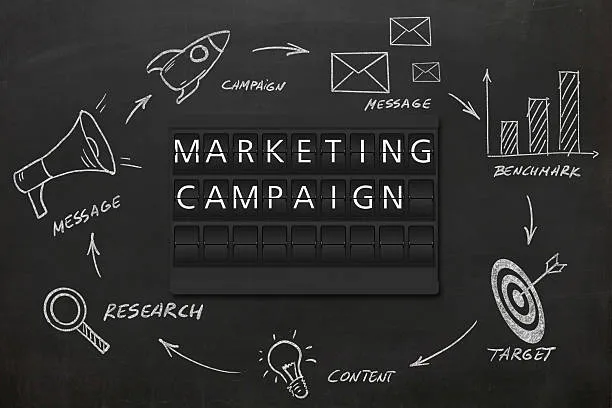
This is followed by precise target definitions and a thorough analysis of the target group. Step by step, this creates a focused keyword strategy that supports your entire campaign.
The next step is implementation: developing creative content, using channels such as SEO and Google Ads in a targeted manner and planning the budget sensibly. Everything is interlinked, efficient and structured.
In the end, it is the result that counts. That is why we continuously measure performance, optimize processes, increase traffic, attract new leads and increase your turnover. Simple, direct and effective.
If you follow this guide, you will achieve top positions in Germany. And to keep it that way, regular monitoring is essential. By analyzing your results and constantly adapting your strategy, you ensure that your campaign remains successful in the long term.
stays.
One easy step-by-step-Accounting instructions can be found here.
Basics: What is an online marketing campaign?
An online marketing campaign is a strategic initiative to achieve specific business goals.
.webp)
It is implemented through various digital channels. This includes social media, email, and search engines.
These campaigns consist of several steps.
Each step is carefully planned and coordinated.
The focus is on reaching the defined target group.
The elements of a successful online campaign include:
- objective: Set clear and measurable goals.
- Target group analysis: Understanding the needs of the target group
- content creation: Develop relevant and engaging content.
Online marketing campaigns are flexible and easy to adapt.
This characteristic feature makes them extremely effective in the dynamic digital world.
Through continuous monitoring and adjustment, companies can achieve effective results.
Goal definition: Set clear goals for your campaign
A clear definition of goals is the first step towards a successful online marketing campaign.

It helps to maintain focus and measure results.
SMART goals are particularly helpful: specific, measurable, achievable, relevant and time-bound.
Before you start your campaign, ask yourself: What do I want to achieve?
This could be an increase in brand awareness, more website visitors, or increased sales figures.
With specific goals, you can better align your strategy.
Setting measurable goals makes it easier to monitor success.
Consider which key figures (KPIs) are important.
This could be conversion rate, click rate, or reach.
Use these metrics to keep track of your progress.
A goal must be achievable but also challenging.
Set realistic goals that still motivate your employees.
Evaluate your resources and capabilities before you commit.
Relevance is another key.
Make sure that your goals are in line with the overall business goals.
They should have direct benefits for the company and contribute to the achievement of long-term goals.
Why professional bookkeeping Promotes growth, we explain here:
Target group analysis and persona development

Target group analysis is essential for the success of your online marketing campaign.
It makes it possible to design your messages precisely and communicate them effectively.
Before you launch your campaign, you should have a clear picture of your audience.
One effective way to identify your target audience is to create personas.
Personas are fictional characters that represent the characteristics of your ideal customers.
They are based on real data and experienced insights.
When developing personas, you should consider the following points:
- Demographic information (age, gender, income)
- Interests and hobbies
- Online behavior and preferred channels
- Challenges and needs
- Buying motives and decision-making processes
It's important to regularly review and adjust your personas. Markets and consumer trends are constantly changing.
A flexible strategy ensures that you always reach the right people.
Knowledge of your target group enables tailored content that is appealing and relevant.
This increases the likelihood that your marketing messages will be received positively.
Finally, a thorough target group analysis leads to more efficient campaigns with a higher return on investment.
Keyword and keyword research for campaigns
Thorough search term and keyword research lays the foundation for the success of your campaigns.

It helps you reach the right target group and increase traffic to your website.
Without well-founded research, campaigns run the risk of running into nothing.
Start by analyzing current trends and popular keywords that fit your industry.
Use tools such as Google Keyword Planner or SEMrush to do this.
These tools give you valuable insights into search volume, competition, and CPC data.
Here are a few steps to effective keyword research:
- Identify relevant search terms
- Analyze search volume and competitive strength
- Choose long-term and specialized keywords for targeted results.
Keyword and keyword research for campaigns is the key to success.
Hello! Are you looking for the right keywords? That makes your campaign unbeatable.
There are over 90 million monthly Google searches in Germany.
Start like this:
- Use tools. Google Keyword Planner is free. Ahrefs shows volumes of up to 100,000 searches/month.
- SEMrush precisely analyses competition.
- Find long-tail keywords. “Online marketing campaign planning tips” has 1,200 searches.
- Less competition, higher conversion rate of 5-10%
- Check volume. Choose keywords with 500-5,000 searches. 70% traffic comes from that.
- Analyze intent. Informational or transactional? This increases leads by 30%.
Connect everything.
Test weekly. And optimize.
That's when your campaign really rocks! Simple and effective.
Don't forget to regularly review and adjust your keywords.
The market is changing, as are the search habits of your target group.
New trends and keywords are constantly emerging.
Continuously adjusting your keywords keeps your campaigns relevant and competitive.
By implementing the right keywords in your content, you can not only increase your brand's visibility but also ensure that your messages are relevant.
This significantly contributes to higher click rates and better conversions.
Which accounting software It really fits, find out in the comparison report.
Design phase: Develop creative ideas and strategies
The design phase is crucial for the success of an online marketing campaign. Here, creative ideas are developed and strategic approaches are designed.

Creativity and strategy are essential components that must go hand in hand.
Start by brainstorming to gather innovative ideas.
Involve different team members to integrate diverse perspectives.
An inspiring space promotes creativity and contributes to the development of unique concepts.
There are various techniques that help you come up with ideas:
- Mind Mapping: Visual presentation of ideas and links.
- SWOT analysis: Identify strengths, weaknesses, opportunities and risks.
- Scenario development: Future-oriented scenarios to promote creative solutions.
Strategies that emerge from the design phase should be well thought out.
Every strategy must be in line with the defined campaign goals.
Verify that the strategies are realistic, feasible, and tailored to your budget.
Finally, it is important to document your ideas and strategies.
This makes subsequent implementation and adjustment easier.
Use a central documentation system to collect and further develop all suggestions.
Start with a campaign that delivers results and is visible in Germany. Advice at: +49 151 6846 1306
Selection of channels: social media, content marketing & more
Choosing the right channels is crucial for the success of an online marketing campaign.

There are lots of ways to interact with your target audience.
The question is: Where is your target group and how do they prefer to communicate?
Social media has become essential for many companies.
Platforms such as Facebook, Instagram and LinkedIn offer targeted advertising opportunities.
They enable you to connect with specific demographic groups. Identify the platforms that your target audience uses the most.
Content marketing is another powerful channel. High-quality content attracts and engages customers to your company.
Consider what types of content your target audience wants to consume.
Blogs, videos, and podcasts are popular formats that cover various preferences.
Here's a list of other potential channels:
- email marketing: Direct and personalized.
- SEO: Increase visibility in search engines.
- influencer marketing: Outreach across prominent personalities.
Don't forget to monitor the performance of each channel.
Measure interactions and adjustments to make your campaign more effective.
A flexible strategy allows you to make changes based on results.
Budget planning and resource management
A well-thought-out budget is the backbone of every successful campaign.

It ensures that your resources are used efficiently.
When planning the budget, all spending points should be considered.
Identify the key cost points of your campaign.
This includes advertising costs, content production, and possibly costs for external service providers.
A detailed budget plan helps to avoid unexpected expenses.
Here's a list of areas to consider in your budget:
- advertising spending: Advertising costs on various platforms.
- Human resources: Salaries and fees for team members.
- technology: Costs for tools and software.
Efficient resource management means making optimal use of your available resources. Prioritize activities that have the biggest impact on your goals.
Flexibility in budget management enables you to react quickly to changes.
Campaign planning: timeline, milestones, and tasks
A solid timeline is critical to the success of your campaign.
He ensures that all activities are completed on time.
The schedule helps to avoid bottlenecks and optimize the workflow.
Start by setting clear milestones.
These serve as milestones and motivate your team to work towards the end goal.
Each milestone should be linked to specific tasks to measure progress.
Here are a few steps to create an effective schedule:
- objective: Define clear, measurable goals.
- task lists: Break down each goal into smaller tasks.
- milestones: Set fixed deadlines for important project phases.
Clarify responsibilities by assigning specific team members to tasks.
This promotes accountability and ensures that nothing is overlooked.
A well-organized schedule with clear milestones and tasks ensures a smooth campaign and helps achieve the desired effect.
You can find answers to the most important accounting questions here.
Implementation: content creation, social media marketing & automation
Implementation: content creation, social media marketing & automation.
Hello! This is where it gets exciting.
Create content that captivates. Use social media smartly.
And automate processes.
In Germany, 81.4% of Internet users are active on social media.
Proceed as follows:
- Plan content. Create videos and reels.
YouTube has 70 million users per month. Carousel posts reach 2,600 users.
- Push social media. Instagram and TikTok dominate. 34 hours spent on TikTok per user.
Klarwerk masters that perfectly.
- Automate Tools like Hootsuite post automatically.
Save 50% time. Increase engagement by 30%.
- Install measurement. CTR on Instagram: 0.22% Optimize weekly.
Leads then explode.
Monitoring, analysis and optimization
The implementation of your campaign is followed by monitoring.

It's critical to continuously monitor how your campaign is performing.
This allows quick adjustments to improve results.
The analysis provides insights into user behavior.
Research which content works best and which channels bring in the most traffic.
Data-driven decisions are key.
To optimize your campaign, consider the following:
- Engagement rates: How much interaction does your content generate?
- conversion rates: Does the target group become customers?
- feedback: What do customers say about your campaign?
Regular A/B testing is an effective means of optimization.
They make it possible to test different variants of your campaign against each other and choose the most successful strategy.
This is particularly useful for identifying the best call-to-action or determining the preferred design.
Optimization is an ongoing process.
Through continuous learning and adaptation, you not only improve the ongoing campaign, but also lay the foundation for future success.
This is how you sustainably increase your return on investment (ROI).
Avoid best practices, trends & common mistakes
Successful online marketing campaigns are based on proven best practices.

These include clear objectives, comprehensive target group analysis and the use of data-driven insights.
Rely on creative content that authentically represents your brand.
Stay up to date on the latest trends.
Technologies and platforms are constantly evolving. Social media and video marketing, for example, are becoming increasingly important.
Integrative approaches that combine various marketing channels are often more effective than isolated measures.
To avoid common mistakes, keep in mind the following points:
- Inadequate target group analysis: If you don't know your target group exactly, this results in low engagement.
- Lack of adjustment: Ignoring changes in the market can lead to irrelevant campaigns.
- No measurement of success: Without analysis, you won't know whether your campaign was successful.
By implementing proven methods and avoiding common pitfalls, you ensure the long-term success of your campaigns.
FAQ:
Planning online marketing campaigns — From idea to results: How do I start?
Hello! It's super easy.
Start with clear goals.
Define your target group precisely.
And choose the appropriate channels.
This is how your campaign is a success.
We're happy to help.
How do I define goals for online marketing campaigns?
Good day! First, set SMART goals.
Specific, measurable, attractive, realistic, scheduled. Think traffic, leads, or revenue.
Tailor it to fit your budget. Successes come quickly.
What tools do I need for campaign planning?
Hello! Google Analytics is great.
You can also use Ahrefs for keywords.
Plan with Trello or Asana.
Everything clearly arranged.
And SEO tools like SEMrush boost results.
Try it out!
How do I measure the success of my online marketing campaigns?
Hello friend! Look at KPIs such as conversion rate.
Track with Google Tag Manager.
Analyze monthly.
Optimize right away. More traffic, more leads — guaranteed!
How do I optimize ongoing online marketing campaigns?
Greet you! Try out A/B variants
Adjust keywords.
Reallocate the budget as needed.
Use data from analytics.
Continuously improve. Your results are exploding!
Conclusion: From idea to measurable results
Planning more effectively online marketingCampaigning requires strategic thinking and adaptability.
From defining clear goals to analyzing the results, every step is critical to success.
Well-thought-out planning, creative content and continuous optimization lead to measurable results.
By always using the latest trends and relying on data analysis, you can successfully achieve your marketing goals.
The journey from concept to implementation requires commitment, but the results are worth the effort.