
.webp)




.png)

In today's fast-paced business world, companies are constantly looking for good ways to clearly set their goals and achieve them successfully. The market is changing, new technologies are being added and customer requirements are changing. Companies therefore need flexible methods to plan their goals correctly. One such method that is becoming increasingly popular is OKRs — i.e. Objectives and Key Results. OKRs help to clearly define goals and accurately measure progress. They show the way from a big vision to concrete steps that are challenging but feasible. In this simple guide for 2025, we explain how companies in Germany can use OKRs in marketing and what benefits this brings.
What are OKRs?
OKRs stand for Objectives and Key Results. It is a goal setting framework that helps companies define ambitious goals (Objectives) and set measurable key results (Key Results) in order to track progress. Originally developed by Intel, OKRs have now found their way into various industries.
The focus is on setting clear, inspiring goals that are supported by precisely measurable results. This not only provides clarity, but also the opportunity to transparently monitor progress and, if necessary, make adjustments.
Also read: SEO & content marketing for sustainable visibility
Why OKRs in marketing?
In marketing, OKRs are particularly useful because they help you keep an eye on the big picture while tracking progress. Marketing departments are often faced with the challenge of aligning their activities with overarching corporate goals.
The complexity of modern marketing strategies requires a high level of coordination and clarity, which can be achieved through OKRs. OKRs offer a flexible and transparent solution that enables teams to prioritize their efforts and use resources efficiently. In addition, they promote communication within the team and across departmental boundaries, which leads to a better understanding of common goals.
Development of marketing OKRs
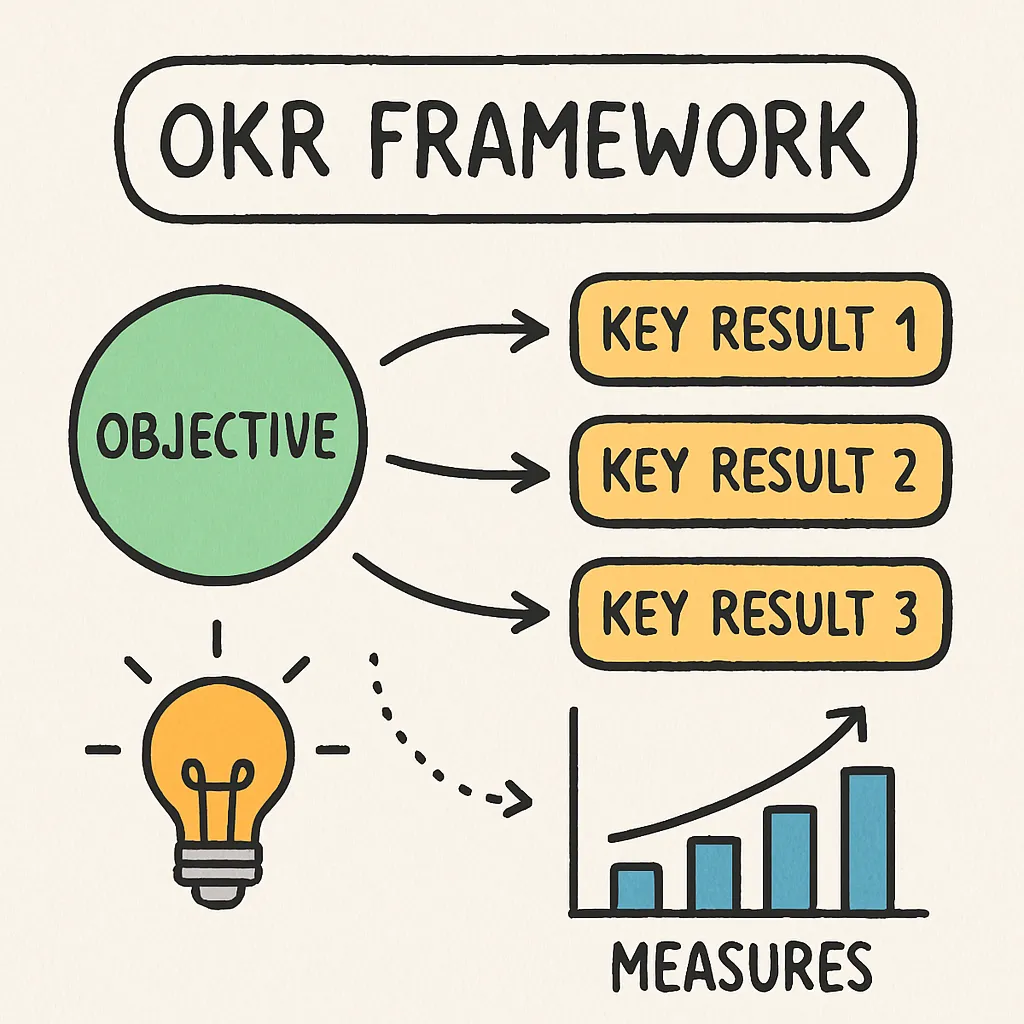
A good OKR framework consists of clearly formulated goals and measurable key results. Each objective should be inspiring and challenging, while key results are concrete and quantifiable. Here is a brief overview of their structure:
- Objective: An inspiring, qualitative goal that is to be achieved. It should be formulated in such a way that it motivates the team and serves as a guide for the next steps.
- Key Results: 3-5 measurable results that define the success of the goal. These should be specific enough to clearly document progress and at the same time flexible enough to allow adjustments as conditions change.
Also read: How to calculate the cost of your website
Marketing OKR example
Objective: Increase brand awareness in the DACH region.
Key Results:
- Reach 10,000 new followers on social media platforms. This should be supported by targeted content strategies and influencer collaborations.
- Increase media coverage by 20% compared to the previous year. This could be achieved by developing new PR campaigns and press releases.
- Increase corporate website traffic by 30% SEO optimizations and paid search campaigns can play a decisive role here.

Practical examples of marketing OKRs
To put theory into practice, here are a few specific examples of what marketing OKRs can look like in different scenarios. These examples should serve as inspiration for how specific marketing goals can be formulated in various contexts.
Example 1: Introduction of a new product
Objective: Successful market launch of the new “EcoClean” product.
Key Results:
- Generate 5,000 pre-orders within the first three months. This could be promoted through exclusive offers and early bird discounts.
- Reach 50,000 page views on the product-Landing page. A targeted digital advertising campaign can be used for this purpose, which highlights the product and its benefits.
- Increase product mentions by 25% on social media Influencer marketing and user-generated content could help increase visibility.
Example 2: Improving customer engagement
Objective: Increase customer engagement through personalized marketing campaigns.
Key Results:
- Increase click-through rate (CTR) for email campaigns by 15% This can be achieved through audience segmentation and personalized content.
- Reduce subscriber churn by 10% Customer loyalty programs and targeted recovery strategies could be used here.
- Reach 200,000 interactions on social media posts. The target group is actively involved through interactive content and regular updates.
Example 3: Expanding into new markets
Objective: Open up the Spanish market for our software product.
Key Results:
- Acquire 1,000 new customers within the first year. This could be promoted through targeted market entry strategies and partnerships with local companies.
- Translate and localize the website and marketing materials within three months A thorough market analysis and collaboration with local translators would be crucial.
- Host at least two webinars with a total of 500 participants. These could address the specific needs and challenges of the Spanish market.
Tips for successfully implementing marketing OKRs
Implementing OKRs can be a challenge. Here are a few tips to make the process easier and ensure that OKRs are effectively integrated into the company structure:
- Clarity and focus: Make sure your goals are clear and concise. Avoid too many OKRs at the same time so as not to lose focus. Less is often more when it comes to using resources efficiently.
- Regular review: Schedule regular meetings to review progress and make adjustments as needed. This allows teams to react flexibly to unexpected changes.
- Encourage transparency: Share OKRs with the entire team to create a shared vision and encourage collaboration. Transparency creates trust and promotes motivation within the team.
- Get feedback: Use feedback from the team to continuously improve and adjust OKRs. This ensures that goals remain realistic and meet changing business requirements.
Read also: Creative web design in Munich
Marketing OKRs for more success in German marketing
Marketing OKRs help companies in Germany to clearly structure their marketing goals and make them measurable. With this method, marketing teams can work in a focused manner, track progress, and react quickly to changes in the market. This makes the achievement of ambitious goals predictable and transparent.If you are looking for support in implementing marketing OKRs, the klarkwerk agency will be happy to help you. Contact us to successfully implement your marketing strategy with clear goals and achieve sustainable growth.
Start now with clear goals and measurable results! Contact You Klarwerk agency to optimize your marketing strategy with effective OKRs and achieve sustainable growth in Germany.
conclusion
OKRs are an excellent way to define clear marketing goals and measure progress efficiently. They help set strategic priorities and make optimal use of resources. With the right OKRs, marketing teams can make strategic decisions that directly contribute to achieving business goals. By using the principles and examples presented here, you'll be well prepared to successfully shape your marketing strategy in 2026 and beyond.
Although integrating OKRs into your marketing planning requires some effort at first, this effort will pay off in the long term through increased efficiency and better results. Companies that use OKRs effectively are better positioned to respond flexibly to market changes and achieve their growth goals. Take advantage of OKRs and transform your marketing efforts today to secure a competitive advantage and achieve sustainable success.