
.webp)




.png)
When liquidity becomes scarce, the problem is often not turnover but timing: Invoices go out, payments arrive too late, incoming invoices are overlooked — and suddenly the cash flow is uneasy. This is where it helps Open accounting items: It creates transparency about due receivables and liabilities, accelerates incoming payments and makes liquidity planning possible in practice.
Especially in Munich, where rent, personnel and operating costs are high, clean open item management often determines whether a company grows in a relaxed manner or is constantly “running behind”. This article provides you with clear, actionable guidelines: from basics to processes to key figures, reminders and tools — without technical jargon.

Open accounting items
Open items are Invoices that have not yet been settled. There are two ways of looking:
- debtors: Customers have not yet paid (receivables).
- creditors: You have not paid yet (liabilities).
A clean surgical overview answers three questions a day:
- What is overdue and does it have to be traced?
- What will over the next 7/14/30 days due?
- Which amounts relate to Top customers, regular customers or Risk cases?
To ensure that this does not end in Excel chaos, a clear workflow is crucial — and often also a reliable basis for processes and communication. If you want to structure your overall visibility and demand at the same time, this is a good addition Advertising & marketing at the points where invoice volumes should be more predictable.
Important for practice
Open items are not an “accounting extra.” They are a management tool: Anyone who does not actively manage OPs does not manage liquidity — but hopes.
Cash flow and liquidity
Liquidity means: Financial solvency today and tomorrow. Cash flow means: How money flows in and out. Open items have a direct effect on both.
Typical effects in SMEs
- 10-20 outstanding invoices “small” seem harmless — but together they can block several months' rent or salaries.
- Late payments force current accounts, lease extension or supplier default.
- Unclear payment terms lead to misunderstandings and cost support time.
Quick profit in Munich
- Shorter payment terms for new customers
- Clear processes for partial invoices and deductions
- Quick billing based on service
- Consistent, polite dunning
If you are actively planning growth, it is smart not to see receivables management in isolation, but as part of an overall system. For predictable new customer flows (so that surgeries do not occur randomly), Lead generation agency for sustainable growth be a useful component.
Open items accounting processes
This is where the biggest lever lies: Not “more reminders,” but better processes. A good process is short, clear, and repeatable.
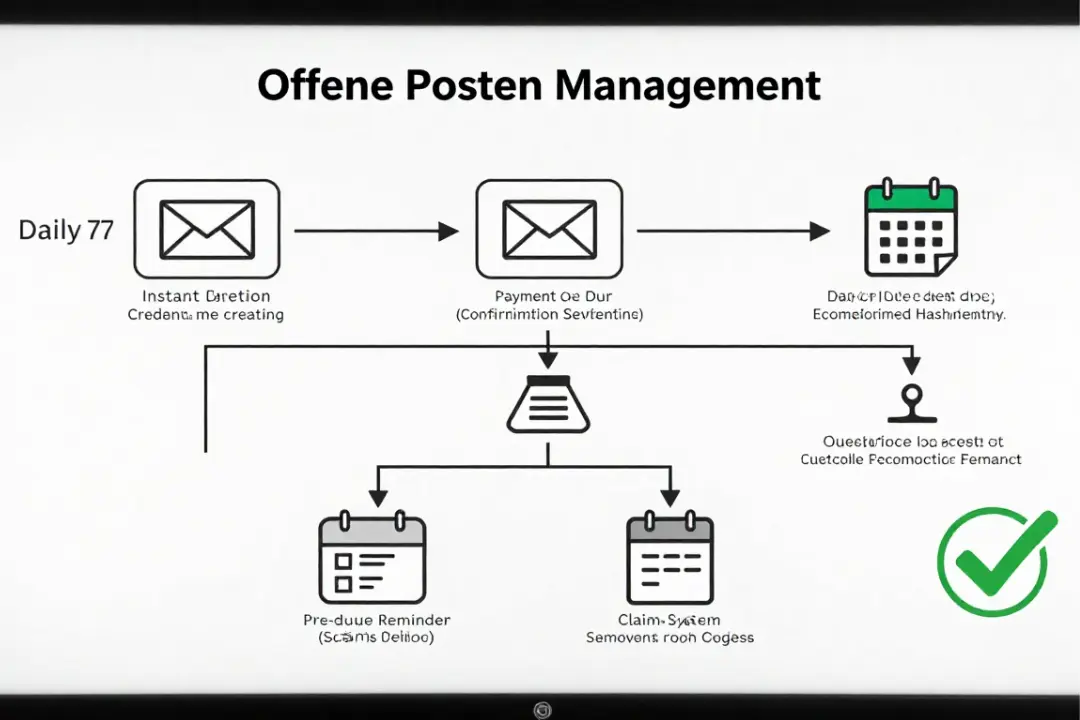
OP process in 7 steps
- Create an invoice immediately
- ideal: on the day of delivery/service
- Mandatory information is complete (see next chapter)
- Payment term clear
- e.g. “payable within 14 days”
- Optionally formulate a clear discount
- Send an invoice verifiably
- Email with correct recipient address
- for larger sums: read confirmation or customer portal
- Surgical list updated daily
- Add new invoices
- Incoming payments out
- Allocate installments correctly
- Payment reminder before due
- friendly, short, with invoice again attached
- particularly effective for regular customers
- Dunning according to plan
- Reminder, 2nd reminder, last reminder if applicable
- fixed days in the calendar, not “when it is time”
- Separate sewage treatment cases immediately
- Complaint, wrong address, missing order, ambiguity
- Objective: Solving problems, not “just reminding”
Rule of practice
The earlier you react, the more professional it looks — and the more likely you will be paid on time next time.
Correct invoices
Many surgical problems start with an invoice that generates queries. Queries delay payments.
Common mistakes
- wrong company name or address
- unclear service description
- missing order number or contact
- Invoice goes to “info@...” instead of to accounting
- missing payment data (IBAN, purpose of use)
This is how liquid companies do it
- a standard invoice text for payment terms and bank details
- uniform intended use (e.g. invoice number)
- Invoice attachment always as a PDF
- contact person Clearly stated for inquiries
If your billing and accounting setup is fundamentally shaky (receipts, filing, responsibilities), it's worth taking a look at Accounting & office management, because surgery management remains permanently difficult without order in the back office.
Reminders and tonality
A good reminder system is polite, clear and consistent. It protects the relationship — and sets limits.
Rhythm example
- Day 0: Due date
- Day 3-5: Payment reminder
- Day 10-14: 1st reminder
- Day 21-28: 2nd reminder
- Day 35+: last reminder or handover to debt collector/lawyer (depending on amount and risk)
What counts legally in Germany
- In many cases, the debtor comes only by reminder in default if payment is not made after due date.
- There are also cases where delay without reminder occurrence (e.g. payment date determined by calendar). There is also a 30-day rule: Delays may occur no later than 30 days after the due date and receipt of the invoice; in the case of consumers, only if they have been specifically notified of this consequence.
- Interest on arrears: Basically 5 percentage points above base interest rate (consumer) and 9 percentage points above base interest rate in the B2B sector.
important
This article is not legal advice. Legal review makes sense for disputed individual cases — but the process logic remains: clarify quickly, document cleanly, act consistently.
Metrics and control
Without key figures, surgical management becomes a gut feeling. With 3-5 numbers, you can control reliably.
KPIs for open items
- Overdue amount (absolutely)
- Share overdue (overdue/total receivables)
- DSO (Days Sales Outstanding) as a rough guide: How many days does it take on average for customers to pay?
- Top 10 risk: Proportion of largest open invoices
- Sewage rate: How many invoices are blocked due to inquiries?
Mini routine for the week
- monday: Check the OP list, set priorities
- wednesday: Follow-up for top 5 overdue cases
- friday: Close treatment cases, prepare next week
If you want to combine your OR management with strategy and growth (e.g. prices, packages, process costs), this is also a good fit Business consulting & strategy.
Automation and tools
Many Munich-based SMEs lose money not because of bad customers, but because of loss of time: manual sorting, searching, remembering
Automation that pays off right away
- automatic payment reminder (e.g. 3 days before due date)
- Reminder levels with templates
- automatic OP allocation via purpose of use/invoice number
- digital filing: invoice, delivery note, email history in one place
- Task workflow: “Who does what by when”
Check before buying tools
- Can the system cleanly separate debtors and creditors?
- Are there clear reminder steps and protocols?
- Does it support DATEV export or common interfaces?
- Can multiple users receive roles (boss, accounting, sales)?
And if your website or customer communication (forms, tracking, processes) is not technically clean, this often also has an effect on invoice quality and clarification cases. Then is Web design & web development not just “marketing”, but process quality.
Risks and prevention
OP management is also risk management. The goal is not to “be tough,” but Prevent outages.
Early warning signs for customers
- constantly new excuses without a specific date
- changing contacts
- Complaints only after a reminder
- Partial payment without confirmation
- “We'll pay next week” several times
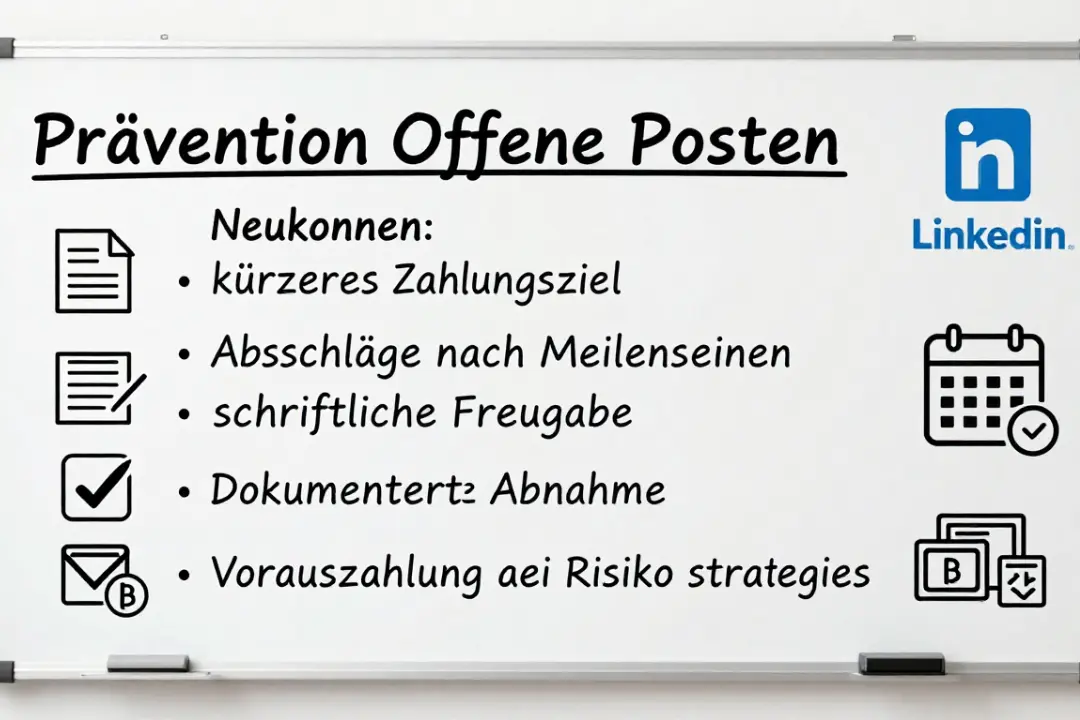
Prevention with simple rules
- New customers: shorter payment term or partial payment
- larger projects: discounts by milestones
- written approval of offers
- documented decrease in performance
- In case of risk: delivery/service only after payment
If you also set up your B2B communication professionally (decision makers, LinkedIn, offer packages), you can LinkedIn ads agency for successful B2B campaigns help to reach suitable, high-paying customers in a more targeted manner.
Contact for improvement
If you have the feeling that your surgeries are “actually okay,” but the cash flow is still fluctuating, it's often due to small details: incorrect responsibilities, lack of routine, late billing, or too many clarification cases.
Contact in 15 minutes
Save 30% today | Plan in 15 mins
📩 Email: info@clearworks-bs.com 📞 +49 157 9249 7112 ☎️ +49 89 3816 9101
Open items accounting checklist
Use this checklist as a weekly standard. It is deliberately short — so that it is implemented.
Weekly
- OP list updated (debtors and creditors)
- Top 10 overdue cases prioritized
- Payment reminders out
- Clarification cases resolved or scheduled
- Notes documented (email, telephone, confirmation)
monthly
- Roughly check DSO
- Root cause analysis: Why do customers pay late
- Check payment terms and discount rules
- Improve templates (invoice, reminder, reminder)
- Optimize the process “from offer to invoice”
Particularly relevant for Munich
- Plan for seasonal peaks (e.g. construction, catering, events) early
- Include personnel and rental costs as a fixed cash flow burden
- Work consistently with discounts for major projects
If you want to focus your entire focus on predictable growth, the change of perspective helps: not just “managing OPs,” but “cash flow as a system.” To do this, it often makes sense to compare providers in a structured way — for example via Compare and correctly select management consultancies.
Book 15 minutes now
Save 30% today | Plan in 15 mins
📩 Email: info@clearworks-bs.com 📞 +49 157 9249 7112 ☎️ +49 89 3816 9101
FAQ
1 What does open item accounting mean
It manages unpaid customer invoices and outstanding vendor invoices so you can manage due dates, overdue dates, and cash flow.
2 How often should I check surgeries
At least weekly, preferably daily or automated for many invoices.
3 When should I warn
As soon as an invoice is overdue and no clarification is pending. A fixed rhythm looks professional and reduces excuses.
4 Which key figure is most important
For many SMEs, the sum of overdue receivables plus DSO is the most helpful guide.
5 What is the fastest lever
Immediate invoicing, clear payment terms and an early payment reminder before the due date.
conclusion
Open accounting items is one of the fastest routes to more liquidity, less stress and predictable growth — especially in Munich. If you clean invoices, maintain surgeries consistently, resolve sewage cases quickly and establish a friendly, fixed dunning system, the cash flow often stabilizes noticeably. It is not perfection that is decisive, but routine: a process that runs every week.
Sources and external links
- Section 286 BGB Delay by the debtor: (Laws on the Internet)
- Section 288 BGB default interest: (Laws on the Internet)