
.webp)




.png)
If a website does not rank despite good content, it is very often not because of “too little text”, but because of technology, structure and clarity. Pages are slow, internal links lead nowhere, meta data is duplicated, important URLs are not indexed correctly — and Google doesn't understand which page is relevant for what. This is exactly where a Onpage seo agency to: It makes your website technically clean, structures content logically and creates the basis for stable rankings.
In Munich in particular, competition is high in many industries. If you want to be visible in Google, you not only need good offers, but also a website that loads quickly, allows you to crawl cleanly and immediately leads users to their goals. This guide gives you a practical roadmap of how on-page SEO really works — understandable, implementable and without unnecessary complexity.

Onpage SEO agency benefits
Onpage SEO is everything on your website happens: Technology, structure, content, internal linking and user guidance. The benefits can be measured directly.
What improves on-page optimization
- indexation: Google can find and understand your important pages
- Rankings: clear relevance signals instead of “keyword salad”
- performance: faster loading times and better usability
- Conversions: Visitors are more likely to make inquiries, appointments or purchases
- scaling: new pages can be easily expanded by system
When onpage SEO is particularly important
- Relaunch or new design
- many pages without a clear structure
- falling visibility or stagnating rankings
- slow website or poor mobile usability
- Local competition in Munich is strong
When your website is technically shaking, on-page SEO is often the fastest lever — and that is exactly why it is often used together with Web design & web development designed so that structure and technology really fit together.
Check the technical basis
Technical SEO is the foundation. Without a clean basis, content and backlinks can be significantly less effective.
The most important technical areas
- Crawling and indexing: What can Google see, what not?
- status codes: Use 200, 301, 404, 410 correctly
- Canonical tags: Avoid duplicate content
- Site map and robots: clean control for search engines
- Mobile display: clear usability on smartphones
- Core Web Vitals: speed, stability, interaction
Google describes basic technical requirements (e.g. accessible content, correct crawling/indexing) in the “Technical Requirements.”
Practice check in 10 minutes
- Are there a lot of 404 pages?
- Are there multiple URLs with the same content?
- Does the start page load slowly on mobile?
- Are important pages blocked by robots by mistake?
- Are filter pages or internal search pages indexed?
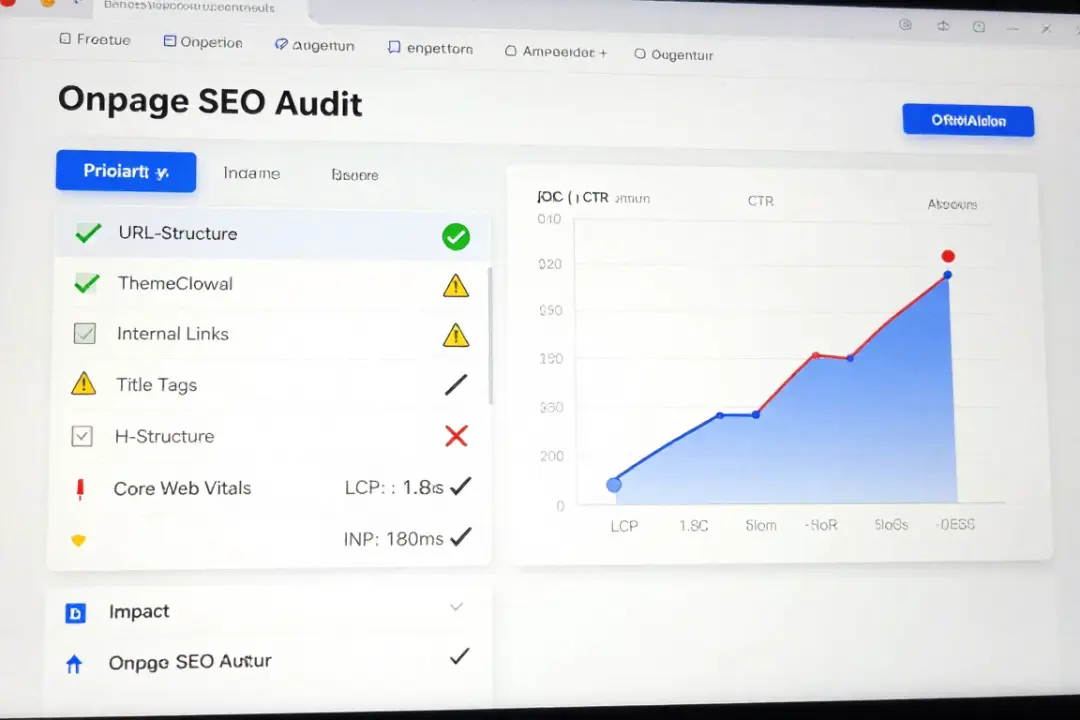
Onpage SEO agency audit
A professional on-page audit is not a PDF for filing, but a prioritized to-do list after impact.
Audit components that really count
- URL structure: short, logical, consistent
- information architecture: Topic clusters instead of individual pages
- Internal linking: important pages get link power
- Titles and descriptions: clear, click-strong, not double
- H structure: clear hierarchy, no chaos of headings
- Content quality: Does the page fulfill the search intent?
- Structured data: Schema markup where it makes sense
- performance: LCP, INP, CLS and technical causes
Google cites target values for Core Web Vitals, among others LCP within 2.5 seconds and INP below 200 ms (for good usability).
If you want to generate predictable leads via your website at the same time, it makes sense not to see on-page SEO in isolation, but to combine it with conversion logic — that's right for that Lead generation agency for sustainable growth as a supplement.
Structure and navigation
Many websites lose rankings not because of “missing keywords,” but because Google cannot correctly assign the topics.
This creates a clean structure
- One central page (pillar page) per main topic
- Subpages for sub-topics (clusters)
- Easy way: Home → Services → Details → Contact
- Menu reduced, not overloaded
- Footer for secondary links, not for chaos
Typical mistakes
- 20 pages on the same topic without a clear main page
- Blog posts without internal links to services
- Categories without use (“filing” only)
- click paths that are too deep (important only after 4-5 clicks)
Recommendation for Munich
If you work locally, build content in such a way that Munich and the surrounding area are logically integrated:
- Service pages with local context
- References from the region
- local FAQs (e.g. how to get there, catchment area)
- clear contact options
Internal linking works
Internal links are one of the strongest on-page levers. They help Google understand which pages are important — and they get users to their destination faster.
Rules for strong internal links
- Link from informative pages to money pages (services)
- Use descriptive anchor texts (don't “click here”)
- Place links where the content makes sense
- Avoid 20 links in the paragraph (quality over quantity)
- Update old articles regularly with appropriate links
Onpage is the basis for local visibility, but “being found regionally” requires additional local signals. If that is your goal, it fits Local SEO for more customers from the region as the next step.
Content by search intent
Onpage SEO is not just technology. Content must exactly match the question that users enter on Google.
The 4 most common search intentions
- informational: “What is...”, “How does it work...”
- Commercial: “best”, “comparison”, “costs”
- Transactional: “book”, “buy”, “appointment”
- Navigational: brand/company name
How to optimize content in a meaningful way
- A clear main message in the first 100-150 words
- short paragraphs, lots of bullet points
- Examples from everyday life (e.g. Munich: industries, competition)
- FAQs only if they answer real questions
- no copy-paste, no filler text
If you work for multiple regions (e.g. Munich + other cities), pay particular attention to duplicate content. Better: Clearly identify local differences instead of duplicating pages.
Titles and snippets
Title tag and meta description not only determine rankings, but also clicks. Google can generate title links from various sources, and there are best practices for influencing titles in search results.
Title Best Practices
- Focus keyword as far ahead as possible
- clear benefits instead of just “service + city”
- No duplicate titles
- not too long but also not too short (clarity before character limit)
Meta Description Best Practices
- Briefly explain what the user gets
- Advantage + Trust + Next Step
- No keyword stuffing
Optimize Core Web Vitals
Performance is on-page. Not just for Google, but for real people. When pages are slow, bounces increase — and leads drop in.
The three most important values
- LCP: Charging capacity (target: within 2.5 seconds)
- INP: Interaction ability (target: < 200 ms)
- CLS: visual stability (avoid layout jumps)
Typical causes
- images that are too large without compression
- Render blocking through scripts
- no lazy loading strategy
- too many fonts or tracking scripts
- Layout shifts due to banners and late elements
Quick action
- Images in modern formats, correctly sized
- Prioritize critical CSS/JS
- Reduce fonts and load them cleanly
- Simplify above-the-fold
- Check servers and caching
Robots and indexing
robots.txt is useful but dangerous when used incorrectly. Google explains that you can use robots.txt to control crawling traffic, but blocking doesn't automatically prevent a URL from appearing as such when others link to it.
What you control well with robots
- Exclude unimportant areas from crawling (e.g. internal search)
- Limit filter parameters
- Save resources
What you shouldn't do
- Block important pages just because they “don't rank”
- Block PDFs or media if they're part of your strategy
- “trying” to prevent indexing via robots (better: noindex)
If you're not sure, do a clean tech check first before you touch robots.
Tracking and measurability
Onpage SEO without measurability is guesswork. At a minimum, you need:
- Search Console (index, queries, problems)
- Analytics (traffic, engagement, conversions)
- a clear conversion goal (request, date, purchase)
Important measurement points
- Index coverage and errors
- Pages with high impression but low CTR
- Pages with traffic but no conversions
- Pages that are slow or have high bounces
Contact and clarity
If you feel that your website is “actually good,” but rankings are unstable or requests are missing, the cause is often technology, structure, or internal linking.
Contact in 15 minutes
Save 30% today | Plan in 15 mins
+49 151 6846 1306 — info@klarwerk-agentur.de
Onpage and conversion
Onpage SEO doesn't end with ranking. The aim is: Visitors should take action.
Conversion levers that are often missing
- clear CTAs (without overwhelming demands)
- Value proposition above the fold
- trust elements (reviews, references, cases)
- clear packages instead of “contact us” without context
- quick contact channels (telephone, form, appointment)
If you want to present your brand professionally and consistently, a clean visual presence can significantly increase conversion. Fits for that Logo design agency for strong recognition as an addition, because trust often makes the difference at first glance.
Schedule content updates
Many websites publish content and then leave it behind. In competitive markets (such as Munich), pages that are maintained win.
Update routine every 8-12 weeks
- Check search intent: Is the content still appropriate?
- Add or correct internal links
- Optimize snippet (title/description)
- Update examples, numbers, screenshots
- Only add new FAQs if they are really in demand
E-commerce and onpage
If you have a shop, the following also apply:
- clean category structure
- Canonical for variants
- index faceted navigation (filter) in a controlled manner
- Structured product data (scheme)
- internal links from content to categories/products
Team and processes
Onpage SEO only works permanently if it is anchored in everyday life.
Who does what
- Editor: Content + Updates
- Development: Performance + technical fixes
- SEO: audit, priorities, structure
- Management: Objectives + Focus
If your company wants to grow faster in general (not just SEO), it often helps to set clear priorities and solve bottlenecks. For that is Business consulting & strategy A useful component — because SEO sometimes goes nowhere without clear business logic.
Onpage seo agency checklist
Use this checklist as a standard if you want to systematically build up on-page SEO.
technique
- Crawlable, indexable, no blockages
- Site map up to date, no spam URLs
- Status codes clean, redirects correct
- Canonicals set correctly
- Clean mobile display
structure
- clear topic clusters
- internal links with meaning and priority
- no duplicate pages without a concept
- Lean and logical navigation
Content
- Search intent met
- clear heading hierarchy
- Snippet with a strong click
- regular updates scheduled
performance
- LCP, INP, CLS at a glance
- Optimized images, reduced scripts
- Don't overload tracking
Start 15 minutes now
Save 30% today | Plan in 15 mins
+49 1579 2497112 +49 89 38169101 — info@klarwerk-agentur.de
FAQ
1 What does an onpage SEO agency do
It optimizes technology, structure, content, and internal linking so that Google understands your pages better and users can find what they're looking for more quickly.
2 How long does onpage SEO take
First effects are often seen after 2—6 weeks, stable improvements usually after 2—3 months — depending on website size and competition.
3 What is more important technology or content
Both Technology creates indexing and performance, content fulfills search intent. Without technology, content cannot work; without content, there is no goal.
4 Do I need onpage SEO in Munich
Yes, especially when there is strong competition. Clean technology and structure are often the difference between “Page 2” and “Top 3.”
5 Which mistakes are most common
Duplicate content, missing internal links, slow pages, incorrect indexing control and unclear page structure.
conclusion
One Onpage seo agency ensures that your website is technically clean, structurally clear and targeted in terms of content. This is particularly useful in Munich, because competition and click prices are high — and every lost visitor is expensive. When you treat technology, structure, content, and performance as a system, rankings become more stable and queries more predictable.
sources
- Core Web Vitals and Google search results (Google Search Central, DE)
- Technical requirements for Google search (Google Search Central, DE)