
.webp)




.png)

Print is not “old.” Print is strong of trust — if it is done professionally. Especially in Germany and particularly in Munich, where markets are often high-quality and highly competitive, printed communication continues to determine the impact: at trade fairs, in consultations, at the point of sale, in restaurants, in practices, in showrooms or in real estate exposés.
One print design agency ensures that your printed products not only look good, but also technically correct are produced: the right color scheme, the right formats, clean print data, clear legibility and a design that actually sells — without overloading.
This article gives you a practical guide: Which print products make sense, what a strong print process looks like, which print data rules are really important, how to choose paper and finishing, how to avoid mistakes — and how print and digital together create a coherent brand image.

Print design agency benefits
One print design agency is particularly valuable when they Strategy, Design, and Printing Logic connects. Because in print, it's not just “beautiful” that counts, above all, “works reliably.”
What high-quality print media actually bring:
- More trust through feel and quality
- More recognition through consistent design
- Better conversion offline (e.g. appointment, phone call, shop visit)
- More professionalism in initial contact (offers, folders, presentations)
- Less production risk through clean print data
When print is particularly useful (Germany and Munich):
- Trade fair appearances and events
- local service providers, practices, law firms
- Catering (menus, flyers, vouchers)
- Crafts and construction (folders, vehicle lettering layouts, offer folders)
- Real estate (exposés, project brochures)
- premium retail (hangtags, packaging, POS material)
If your brand isn't clear enough yet, it's worth building a solid foundation first Logo design agency for strong recognition — because print reinforces what is already visually defined.
Overview of printed products
A good print portfolio isn't “everything.” It is goal-oriented. Select print products based on the situation and goal.
Typical print products that have proven effective:
- Business cards and appointment cards
- flyers and flyers (promotion, local actions)
- Brochures and image folders
- Offer folders and pitch documents
- posters and posters
- Roll-ups and exhibition graphics
- stickers, labels, hang tags
- Menus and voucher cards
- Stationery and stationery
- Packaging and inserts
Quick decision-making framework:
- Brief contact → Business card, flyer, appointment card
- Offer that requires explanation → Folder, brochure, folder
- Visibility at a distance → poster, rollup, shop window
- Brand moment when unpacking → packaging, insert, thank you card
If you plan print as part of your overall communication, integration is involved Advertising & marketing Sense — so that print does not run in isolation, but consistently supports campaigns and messages.
Print design agency process
One print design agency Ideally, work in clear steps. This makes print predictable, fast and error-free.
Briefing and goal
- Define goal (request, purchase, deadline, attention)
- Define target group (e.g. Munich, surrounding area, B2B decision makers)
- Clarify the location (trade fair, shop, shipping, consultation)
Content and structure
- Key message in 1 sentence
- Use points in 3-5 bullet points
- Proof elements (references, numbers, certificates)
- clear call to action (call, QR, appointment)
Design and layout
- grid, typography, hierarchy
- Consistent imagery and icons
- White space instead of overloading
- Check readability at real size
Print data and approval
- format, trim, color profile
- PDF standard (e.g. PDF/X depending on printer requirements)
- Embed fonts, images correctly
- final check + print approval
If you need to compare multiple service providers, Compare and correctly select management consultancies A good framework for properly evaluating processes, scope of delivery and quality criteria — instead of just comparing “design awards.”
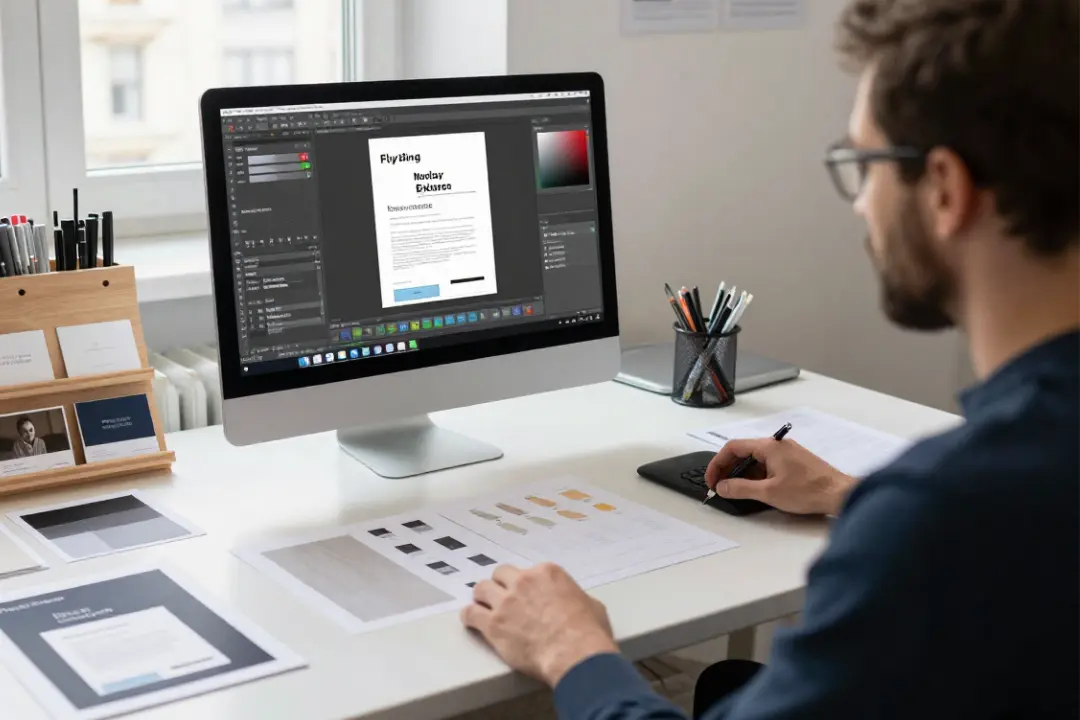
Paper and feel
In print, paper is a silent seller. In Munich, where many industries want to look premium, haptics often decide between “cheap” and “valuable.”
Important terms simply explained:
- grammage: Weight per square meter (e.g. 135 g/m², 250 g/m²)
- volume: How “thick” does paper feel
- surface: matt, glossy, textured
- opacity: How much the paper shines through
Practical recommendations (typical cases):
- Standard flyer: often 130—170 g/m²
- high-quality flyers/folders: often 170—250 g/m²
- Business cards: often 300-450 g/m²
- Brochures: lighter on the inside, stronger on the outside (cover)
This is how you choose correctly:
- For premium: matt, higher volume, subtle structure
- For photos: satin/shiny (but be careful when reflecting)
- For lots of text: matte surface, good readability
- For vouchers: stable grammage + finishing
Colors and printing effect
Many are surprised: What looks good on the screen looks different when printed. That's normal — screens glow, pressure reflects light.
Important basics:
- Print usually works in CMYK, not in RGB
- Color results depend on paper, printing processes, profiles and machines
- dark areas need clean black levels, otherwise they look stained
- Bright neon colors are limited in CMYK (special colors may be)
Practical tips to avoid mistakes:
- Use logos as vector files (AI/SVG/PDF)
- Check skin tones and shades of gray
- Don't plan large areas of color too sensitively
- for critical brand colors: plan for proof or printing
If you also want to represent your brand digitally cleanly, Web design & web development The perfect addition — because a strong brand impact should always be thought of across media today.
Print data without errors
Print data is the point where many projects lose time and money. That is why a clear quality check is worthwhile.
The most important rules (practical):
- Schedule circumcision (often all around, depending on the product)
- Safety distance for text (not too close to the edge)
- Pictures large enough (otherwise pixelated)
- Embed fonts or convert to paths when needed
- PDF/X standard use when the print shop recommends it
- Transparencies clean (especially with effects)
Common mistakes to avoid:
- “Quickly exported as JPG” instead of printable PDF
- missing trim → white edges after cutting
- RGB colors → uncontrollable printing effect
- too thin lines → barely visible in print
- too small font sizes → poor readability
Mini-check before approval:
- Is the final format plus trim correct
- Are texts readable in real size
- Are QR codes tested
- Are contact details error-free
- Is the branding consistent
Typography that sells
In print, typography is immediately rated — especially for brochures, price lists or menus.
Readability rules that work in almost every industry:
- not too many fonts (maximum 2)
- clear hierarchy (headline, intermediate headline, text)
- enough line spacing
- left-aligned running text for long texts
- Clean contrasts (not light gray on white)
Print-specific tips:
- small font needs more contrast
- Paper structure influences sharpness
- very thin fonts may weaken when printed
- It is better to use “quiet” fonts for long texts
Combining print and digital
Print has the strongest effect when it has a digital next step.
Powerful combinations:
- QR code → landing page with suitable offer
- Flyer → Google reviews or appointment booking
- Brochure → Download version as PDF
- Trade show print → Follow-up email sequence
- Coupon → Tracking via codes
If you want more walk-ins or inquiries locally in Munich, the combination of print and Local SEO for more customers from the region particularly strong: Print triggers the impulse, local SEO intercepts the search for it.
Refinement and quality
Refinement is not a luxury when used strategically. It increases attention and value.
Popular finishes:
- soft-touch lamination (high-quality, modern)
- spot varnish (accents, highlights)
- hot foil (premium, eye-catching)
- embossing (haptic, high-quality)
- Die-cutting (form, surprise)
This is how you make a sensible decision:
- If your offer is premium → Refinement can be worthwhile
- If you need large quantities → rather invest in paper and clarity
- when you need to stand out (trade fair, POS) → use spot varnish/embossing specifically
Book 15 mins now
contact: +49 151 6846 1306 · info@klarwerk-agentur.de
Your plan in 15 minutes
Print for Munich
Munich is heavily influenced by industries in which trust and quality must be immediately visible: real estate, consulting, health, gastronomy, premium crafts, culture, events.
What works particularly well in Munich:
- High-quality feel instead of mass-flyer look
- clear communication of benefits instead of “We are the best”
- local references or regional proof elements
- consistent design across all touchpoints
- quick contact channels (telephone, email, QR)
Typical locations of use:
- Messe München and industry events
- Downtown locations and showrooms
- Practices and law firms
- Hotels and restaurants
- local cooperation and sponsorship
Print budget planning
Print can be very cheap or very high-quality. So that you don't calculate “blindly”, you need clear influencing factors.
What typically drives the price:
- Edition and format
- Paper and grammage
- color (4/4, 4/1, etc.)
- Finishing and special colors
- Processing (folding, binding, punching)
- Delivery time and logistics
How to use your budget wisely:
- first: clarity, text, layout, proof elements
- then: choice of paper suitable for the brand
- Finally: Refining only where it has an effect
If you're planning print as part of a larger brand or growth strategy, it helps Business consulting & strategy, so that budget, positioning and channels fit together properly.
Content that works
Many print products fail not because of their design, but because of their content. The best design cannot save unclear statements.
A strong print logic:
- clear headline with benefits
- 3-5 bullet points with specific benefits
- Proof (number, result, reference, certificate)
- simple next step (appointment, call, QR)
Examples of proof without exaggeration:
- “Reply within 24 hours” (if you really think so)
- “Project can start in 7 days” (if you have capacity)
- “X successfully implemented” (if verifiable)
Common print errors
If you avoid these points, you'll be immediately ahead of most competitors in Germany:
- too much text, too little structure
- no clear target group (“for everyone”)
- Poor quality images
- too many fonts and effects
- incorrect format or missing trim
- Not a clear next step
- Print without connection to website or tracking
If you also want to use your material as a “pitch or sales document,” it's worthwhile to build up visual content consistently — here you can media production (video, content, design) help because imagery, icons, photos and infographics then come from one system.
Print design agency selection
If you're looking for an agency, don't just decide by portfolio. Decide based on process and printing expertise.
Good selection criteria:
- Ask the agency about the destination and location
- Does it explain paper, formats and print data in a comprehensible way
- It provides a clear system instead of individual graphics
- Is there a clean correction loop
- Is print shop communication taken into account
- Do you get editable files and clear usage rights
Printdesign agency Klarwerk
If you a print design agency who not only designs, but also understands print as part of your brand and marketing system, is the Klarwerk agency aimed at clear, high-quality and production-ready print media — suitable for Germany and especially for Munich.
What you typically get:
- Advice on format, paper and use
- clear text and layout structure for quick comprehension
- Design system for consistent print products
- Printable data in accordance with current standards
- Coordination for smooth production
Book 15 mins now
+49 1579 2497112 +49 89 38169101 · info@klarwerk-agentur.de
Save 30% today
FAQ
Which printed products are worthwhile first?
Usually business cards, a clear flyer or a short folder and a clean offer folder — depending on the industry and sales process.
Why does print look different from a screen?
Screen colors glow (RGB), printing usually works in CMYK and depends heavily on paper and print profile.
What is circumcision and why is it important?
There is an additional border that is cut off after printing so that there are no white edges.
Do I always need PDF X?
Often yes, because many print shops use PDF/X as a secure standard for print data exchange — but requirements depend on the provider.
How do I combine print with measurable results?
Through QR codes, landing pages, clear contact channels and consistent messages — this is how print becomes the starting point of a measurable funnel.
conclusion
Print works when it clear, high-quality and technically clean is. One print design agency helps you develop print products in such a way that they create trust, increase recognition and trigger the next step — especially in Germany and in the demanding Munich environment.