
.webp)




.png)
Good product images are often the fastest way to sell more — without changing the product. Because no one can touch, feel or test online. Your pictures take on this task: They explain, show details, create trust and reduce uncertainty. This is exactly where a Agency product photos to: It not only delivers “beautiful photos,” but an image strategy that is geared to conversion, brand impact and platform requirements in Germany — particularly relevant in competitive markets such as Munich.
In this guide, you'll get a practical system: Which image types really generate revenue, how a professional shooting process works, which technical requirements (e.g. for Google Shopping) count, how you can plan costs — and how you can use the photos directly for shop, ads, marketplace and social.

Agentur Wirkung product photos
One Agency product photos is particularly valuable when it has visual aesthetics and Sales psychology connects. Because “strong sales” means: The picture answers questions before they arise.
What good product photos actually improve:
- click-through rate in ads and listings (images are often the first eye-catcher)
- Conversion rate in the shop because uncertainty decreases
- Shopping cart valuewhen variants and upsells are presented more clearly
- Queries Support because details are visible
- returnsbecause expectations are becoming more realistic (especially when it comes to colors, sizes, materials)
Why that counts in Germany:
- Customers compare quickly and critically
- Brand trust comes from quality, consistency and professionalism
- Platforms (Google, marketplaces) have clear image requirements
If you want to strengthen the visual recognition of your brand, it is also worthwhile to have a clear foundation of Logo design agency for strong recognition — so that imagery, colors and layouts are consistent everywhere.
Image types that sell
Not every product needs “everything.” But every product needs the types of images that make buying decisions easier.
Packshots and cutouts
- ideal for shop categories, marketplaces, Google Shopping
- clear, neutral, without distraction
- perfect for variants (color, size, set)
detailed images
- show material, structure, seams, surface, connections
- Reduce “What does that feel like? “Ask
- important for premium products
Application images
- show size and context (hand, space, use)
- increase understanding and trust
- particularly relevant for products that require explanation
lifestyle pictures
- Tell a little story
- work strongly in ads, social and branding
- help with positioning (premium, sporty, sustainable, minimalistic)
Set and bundle pictures
- make value visible (“What is included? “)
- reduce complaints
360 degrees and short clips
- increase product understanding
- good for higher-priced products and technology
- strong in marketplace environments and on product pages
If you want to build campaign motifs and advertising material directly from the product photos, the integration fits Advertising & marketing, so that images are not just “content,” but generate measurable demand.
Product photos agency process
A clean process saves time, money and nerves. A good Agency product photos Therefore, work in clear steps that you can easily approve.
Briefing and goals
- What should the image achieve? (click, buy, premium experience, fewer queries)
- Which platforms? (Store, Google Shopping, Amazon, Social Ads, Print)
- Which target group in Germany/Munich?
- Which visual language suits the brand?
Shotlist and style guide
- List per product: Mandatory motifs and optional motifs
- Perspectives: front, side, back, detail, application
- Light look: bright-clean vs moody-premium
- Background: white, colored, environment
- Props: yes/no, which, how much
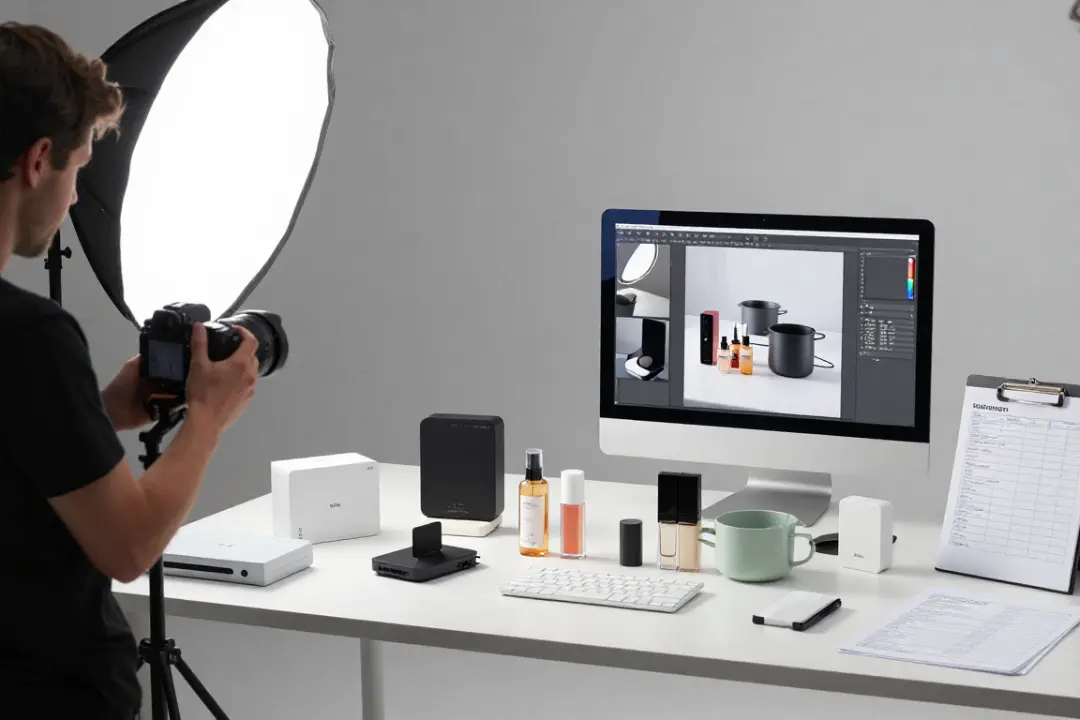
Production and shooting
- Studio or location (e.g. Munich, showroom, kitchen, outdoor)
- Set construction, light setup, color check
- Photography by shotlist, clean tracking of variants
post-production
- Crop, retouch, remove dust/reflections
- Color matching across all products
- Export in appropriate formats and sizes
Delivery and assets
- Web-optimized files for shop
- high-resolution files for print
- Variations by platform (e.g. square for social, 4:5 for ads)
So that your product pages can really “play out” the photos (fast, clean, high-conversion), Web design & web development The right lever — because even strong images sell worse if load times, zoom, gallery and mobile UX aren't right.
Technical image standards
This is where it is decided whether your images work everywhere — or whether platforms reject them or play them out worse.
Resolution and quality
For optimal performance, Google Merchant Center often requires an image size of at least 1,500 × 1,500 pixels recommended.
practice:
- Main image: high enough for zoom and crops
- additional images: same quality, same lighting logic
- no pixels, no artifacts, no blur
Background and overlays
- On many platforms, clear, product-focused images are better without advertising text
- Logos/badges in the image may cause rejections (depending on platform rules)
file formats
- Web: JPG/WebP (fast), PNG when transparency is needed
- Print: TIFF/PDF assets (high-quality) depending on workflow
Color fidelity
- consistent white balance across the entire product line
- For critical colors (fashion, interior, cosmetics), color check and reference
Image weight and load time
- strong images must load quickly
- Objective: visible quality with low file weight (compression clean, WebP where possible)
Conversion through image logic
High-selling images follow a clear sequence. Many shops lose sales because they upload “random” images.
A simple order that works:
- 1 main image clear and iconic
- 2-3 prospects for security
- 1 detailed image for quality
- 1 application for context
- 1 Size comparison or set size
- 1 lifestyle image for Emotion (if appropriate)
Mini-check for every product
- Is the product immediately recognizable?
- Are sizes and proportions clear?
- Are important features visible?
- Can you understand what it's for in 5 seconds?
- Do all variants look consistent?
If you also want to use the image logic as a lead or sales system (e.g. B2B catalog, sample box, appointment request), Lead generation agency for sustainable growth A useful connection, because images + landing page + offer together drive the conversion.
Book 15 minutes now
contact: +49 151 6846 1306 · info@klarwerk-agentur.de
Plan in 15 minutes
E-commerce requirements
In Germany, many sales are made via a mix of online shops, marketplaces and Google Shopping. Every environment has expectations for images.
Shop requirements
- quick gallery, zoom, clear selection of variants
- mobile-first presentation (important details must not be “too small”)
- consistent image edges, same perspectives for each variant
Google Shopping requirements
- clear main images, good resolution
- additional images for more confidence
- As “clean” look as possible without distraction
Among other things, Google describes the principle that more images from multiple angles can make buying decisions easier.
marketplaces
- very strict requirements for each category
- Main image often neutral
- Detailed and application images as a differentiation
Practical tip: If you also want to sell locally in Munich (store, studio, practice, showroom), the combination of shop images and local visibility has an extremely powerful effect. Here helps Local SEO agency for regional findabilityso searchers can find you — and then complete your images.
Shooting planning without stress
Many projects fail not because of the camera, but because of a lack of preparation. This is how you plan smartly:
Prepare products
- clean, without dust, without fingerprints
- Box and set contents are complete
- Variants clearly labelled
Shotlist per SKU
- main image, 2 perspectives, detail, application
- Extras: 360 degrees, packaging, set picture
scheduling
- Packshots are faster than lifestyle
- Variations increase time (any color, any size)
- Props and set construction need advance
Choice of location
- Studio for Consistency
- Location for story (e.g. kitchen, gym, office, outdoor)
- Munich offers many suitable settings, but allow permits and time slots
Post-production that counts
Retouching is not “fake.” It is quality control.
Important retouching work
- Remove dust and micro-scratches
- Edges clean, shadows checked
- Match colors
- Reduce reflections (glass, metal, glossy)
- Background really clean (when cutters)
Consistency is the revenue lever
- same lighting atmosphere across all products
- same camera height and perspective
- same image spacing and crops
Clarify image rights securely
One area that is often underestimated: rights of use. In Germany, image rights are a real risk factor when you “simply use images somewhere” or buy rights too narrowly.
The Chamber of Industry and Commerce points out that licenses can be limited in time, space and content — and that rights for print do not automatically allow online use.
Practical rules that protect you:
- Clarify in writing: Where can the image be used (shop, ads, print, social)
- Clarify the duration (e.g. 2 years or unlimited)
- Clarify the area (Germany, EU, worldwide)
- Allow editing (retouching, cutting, layout)
- Model releases for people
- Property releases at locations, if necessary
Plan your budget realistically
Product photos can be planned if you know the cost drivers:
Typical cost drivers
- Number of products and variants
- Image types (packshot vs lifestyle)
- Set construction and location
- Styling and props
- Retouching effort (material, shine, reflections)
- Express schedule
How to optimize budget without loss of quality
- First packshots for all SKUs (basic)
- then lifestyle for bestsellers (performance)
- then details/360 degrees for premium products
- clear shot list reduces post-shoots
If you want to build print catalogs, flyers or sales documents with the same photos, a clean strategic bracket pays off Business consulting & strategy so that the offer, positioning and visual assets work in one system.
Munich and Germany Focus
The following often applies to Munich: Quality is expected. Many industries are premium, consulting-intensive or highly visual (interior, food, beauty, lifestyle, technology).
What works particularly well in Munich:
- high-quality, calm imagery instead of “cheaply loud”
- real details (material, finish, craft)
- consistent series (not every product is different)
- local story motives (if brand is regional)
Important places of use
- Messe München and industry events
- Showrooms, pop-ups, local collaborations
- Retail and catering (menu cards, displays, shop windows)
.webp)
Klarwerk agency product photos
One Agency product photos is strongest when it not only delivers photos, but a set of assets that you can use directly for shop, ads, social and print — consistently, quickly and technically clean. Die Klarwerk agency That's where it starts: high-selling image series, clear shot lists, clean retouching and an output that works in real sales channels in Germany (including Munich).
What you typically get:
- Image concept suitable for the target group
- Packshots, details and lifestyle according to plan
- Exports for shop and campaigns
- consistent series for variants
- clear use of images in the funnel
Book 15 minutes now
+49 1579 2497112 +49 89 38169101 · info@klarwerk-agentur.de
Save 30% today
FAQ
How many product images per item are ideal?
Usually 5 to 8 pictures: main image, perspectives, detail, application and optional lifestyle.
Do I need cutters on white?
It is very helpful for Google Shopping and many marketplaces. Lifestyle images are often also useful for branding and ads.
What resolution should I provide?
Platforms often recommend high resolutions for optimal display quality; Google Merchant Center often recommends 1,500 × 1,500 pixels.
How do I prevent color deviations?
With consistent lighting, color checks, professional retouching and uniform profiles — particularly important for fashion and interior design.
What do I have to pay attention to when it comes to image rights?
Clarify the scope of use in writing (online, print, ads), duration, area and editing rights — otherwise there is a risk of problems.
conclusion
Good images are a selling point — and in many cases the fastest conversion tool in the shop. With clear image logic, clean technical standards and consistent series production, your product presentation becomes more professional, trustworthy and measurably effective. One Agency product photos helps you to achieve this quality reliably — especially in the demanding environment of Germany and Munich.
Sources and external links
- Google Merchant Center help with image links and recommendations (including 1,500 × 1,500 px): image link image_link
- IHK Schwerin on image rights and scope of licenses (print vs online, spatial/temporal): Image rights Royalty free is not free