
.webp)




.png)
In the everyday life of many companies, accounting eats up exactly the time that actually belongs to growth: offers, customers, team management, product, sales. Accounting outsourcing It is therefore not a “nice-to-have” but a practical lever to free up capacities, reduce errors and standardize processes cleanly.
It is important: Outsourcing does not mean “surrender and forget.” Anyone who outsources must purchase the right services, clarify responsibilities, understand figures and constantly check quality. This guide shows you step-by-step how to outsource accounting — with a focus on Outsource accounting costs, external accounting office, digital document processing, ongoing accounting service and robust accounting processes.

Why outsourcing accounting
Accounting is mandatory, but rarely a core competence. In many SMEs, agencies, craft businesses, online shops or service companies, accounting happens “between projects” — too important to do it on the side, but too time-consuming to provide high-quality staff internally.
Accounting outsourcing becomes particularly attractive if you recognize any of these symptoms:
- You or your team regularly spend several hours a week on documents, assignment, and inquiries.
- Monthly figures come too late or look unreliable.
- There are media breaks: paper, PDFs, emails, Excel, various tools without clear submissions.
- Knowledge depends on a person (vacation/illness = standstill).
- The company is growing — but administration should not grow at the same pace.
Outsourcing is not either/or. It is a modular system: You can only outsource some areas (e.g. document management), or establish a complete routine (e.g. monthly financial statements + OP lists + reporting).
When you gain focus, it pays to use it strategically — for example by systematically building up your visibility at the same time instead of “someday.” A good start is: DIY SEO: Tips for beginners.
When outsourcing makes sense
Outsourcing makes sense when the benefits outweigh the coordination effort. Typical times:
- Before a growth step (more customers, more team, more documents).
- When you for the first time monthly reporting need (liquidity, cost blocks, open items).
- When “too many hands” book internally or the filing and flow of documents is unclear.
- If you want to put things in order before the financial statements so that there are no hectic corrections.
Quick reality check
If you are unable to answer these questions with certainty, there is usually a lack of structure:
- How high are outstanding receivables (customers owe you money)?
- How high are outstanding liabilities (you owe suppliers)?
- How much liquidity will remain after fixed costs in 30 days?
- Which 3 cost items are currently the biggest drivers?
Outsourcing acts like a “structural magnifying glass” here: It requires clear data channels, unambiguous approvals and comprehensible processes.
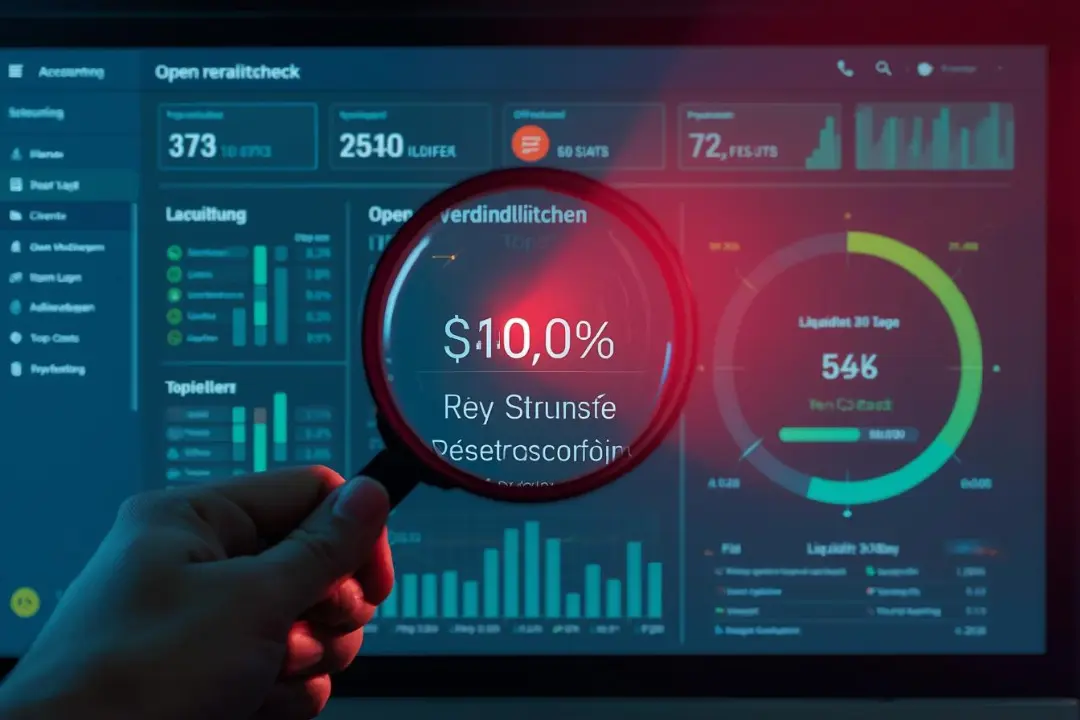
Accounting outsourcing benefits
For the benefits to be real, processes and expectations must be right. This results in four noticeable effects:
More focus in everyday life
You gain time for sales, customer relationships, team management and product quality — instead of looking for evidence or clarifying questions.
Better data quality
Professional routine reduces typical mistakes:
- duplicate receipts
- wrongly assigned payments
- missing mandatory information
- messy storage
- incomplete documentation
Scalability without bureaucracy
If document volume increases, there is no need to automatically set an additional header internally. An external service can often cushion volumes more easily.
Quieter risk profile
With a clean archive, clear access rights and documented processes, the risk of important evidence missing or processes collapsing in the event of illness is reduced.
If you are faced with the decision to “do it yourself or outsource”, a brief change of perspective helps: It is often not the pure accounting costs, but the opportunity costs (time, errors, delays). This is suitable as a supplementary reading: 5 benefits of outsourcing your bookkeeping.
Vendors and models
Outsourcing does not automatically mean “tax advisor does everything.” In practice, there are three common models:
tax consulting firm
Suitable if you want bookkeeping, financial statements and tax issues from a single source if possible. Advantage: strong standardization and experience in dealing with audit trails. Disadvantage: Depending on the law firm, operational processes are less flexible.
External accounting service
Suitable for ongoing routines: document management, account assignment, surgical lists, monthly routines, preparatory activities. Advantage: often very process and tool-oriented. Disadvantage: Tax advice is usually not part of the scope.
Hybrid internal plus external
Very common in SMEs:
- Internal: document flow, approvals, payment approval, cost center logic
- External: Processing, account assignment, monthly routine, reporting preparation
recommendation: Decide not by “name”, but by process fit. A provider is only as good as the collaboration: response times, clear checklists, interface expertise, documented handovers.
Outsource accounting costs
The question “What does it cost? “is justified. But: A prize without context is rarely helpful. Outsource accounting costs almost always depend on five drivers:
- Document quantity per month
- Complexity (e.g. projects, many payment methods, international issues)
- Level of digitization (clean digital = less effort)
- Response rate (missing information drives costs)
- desired additional services (OP, dunning, reporting, forecast)
Pricing models you'll see
- Monthly flat rates based on document packages (easy to plan)
- Billing based on expenditure (flexible but less predictable)
- Tax advisors often charge limits in accordance with StBVV (depending on value)
How to obtain comparable offers
Require the same structure from all providers:
- What is included (bank, cash register, debtors/creditors, OP, monthly statement)?
- Which tools and interfaces are used?
- How do inquiries go (rhythm, channel, response time)?
- What quality assurance is there (four-eyes, random samples, monthly review)?
- What are the one-time onboarding costs?
If you are already clarifying your cost logic, it often helps to look at cost factors in other areas, because the thinking is similar: transparent, modular, predictable. That is exactly what this article is good for: Understanding cost factors in website optimization.
In addition, a realistic “baseline” is worthwhile for accounting: How much does your internal time cost per hour? What do mistakes cost (reminder stages, missed deadlines, wrong decisions)? Outsourcing is often not “cheaper”, but more economicalbecause it frees up time and stabilizes quality.
If you're looking for a specific price orientation without getting lost in estimates, this article is helpful: How much does an accounting service really cost.
Digital document processing
The biggest leverage in outsourcing is almost always digital document processing. Because: When documents arrive cleanly digitally, are correctly named and approvals are regulated, costs are reduced — and quality increases.
Target image of a clean document path
- Documents come in digitally (upload, scan app, email rules, e-bill)
- clear allocation (supplier, date, amount, project/cost center)
- Approval logic (who is allowed to release what?)
- audit-proof filing + quick access
- Transfer to accounting without media disruption
Common mistakes that get expensive
- Documents are stored in chats, screenshots, private mailboxes.
- No uniform naming or filing structure.
- Approvals are made orally rather than documented.
- Bank payments cannot be clearly assigned to receipts.

Mini-standard for your team
- Each invoice has an owner (responsible for context/project/cost center).
- Approval within 48 hours.
- One channel for inquiries (not five).
- A place as a “single source of truth” (tool/folder).
When digital documents run smoothly, not only do accounting and tax offices benefit, but also your management: Figures come faster, decisions become clearer, and liquidity planning suddenly becomes practicable.
Ongoing accounting service
A good ongoing accounting service is more than “booking”. It provides rhythm, clarity and decision-making certainty.
What a strong ongoing service covers
- Regular processing of bank/cash/receipts
- Open item lists (receivables and liabilities)
- plausibility checks (unusual transactions, duplicate receipts)
- monthly routine (fixed date, clear process, defined results)
- Handover to tax advisors/annual financial statements without chaos
Which evaluations are really useful
Start lean so you can use it:
- Liquidity status (short term)
- OP list (who pays, who do you pay)
- Top cost blocks (3—7 positions)
- optional: project/cost center overview (if your work is project-driven)
Important: Many companies pay for reporting that no one reads. Better: few key figures, regularly, consistently.
Accounting processes
Outsourcing only works with clear accounting processes. Anything that is not defined comes back later as a query or additional effort.
Separate rolls cleanly
- Company: provides receipts + context, approves payments, maintains responsibility
- Service provider: processes, accounts, documents, reports abnormalities, provides evaluations
A simple control system
- Weekly: document status + open inquiries
- Monthly: 15-30 minute review (surgery, abnormalities, cash, top costs)
- Quarterly: process check (interfaces, accesses, approvals, documentation)
Key figures that make quality measurable
- Proportion of receipts without inquiry
- Processing time document → posted
- Number of corrections per month
- OP overdue (how many invoices are past due)
When you establish such routines, you automatically create more “business peace.” And this peace of mind is often the moment when companies are actively planning growth again — including campaigns that are not improvised but structured. A good structure can be found here: Planning online marketing campaigns From idea to results.
Risks and compliance
Outsourcing reduces risks—but only if you don't “outsource” compliance. Three areas are crucial:
Storage and archiving
There are fixed storage periods in Germany. Since 2025, the deadline for certain accounting documents (e.g. invoices/cost documents) has been set to 8 years abbreviated while other documents continue 10 years (e.g. books, annual financial statements) or 6 years (other business documents) must be kept. Your archive must reliably represent this.
GoBD and traceability
Electronic documents must be comprehensible, complete, accurate, timely, organized and protected against uncontrolled changes. This includes documentation, access concepts and a stable flow of documents.
Data protection and access rights
- Role-based accesses
- 2FA and clear offboarding processes
- AV contract/data protection agreements for personal data
Practical tip: Think like you would in performance marketing: measure, test, optimize. Small levers go a long way — and that's exactly how you should manage your accounting quality. If you also want to control your advertising spending on the side, you will find quick optimization levers here: Google Ads optimize 10 quick performance levers.
Implementation step by step
So that outsourcing doesn't end in “email ping pong,” you need a clear process.
Step 1 Set goals
- Save time?
- better numbers?
- Scaling?
- less risk?
Write down 3 goals. Anything that doesn't contribute to these goals is “nice-to-have” later on.
Step 2 Define scope
- Only document processing?
- Bank/cash desk included?
- OP lists and reminders?
- monthly reporting?
The clearer the scope, the more comparable offers are.
Step 3 Standardize document flow
- input channels
- naming/assignment
- Approval process
- Inquiry process
Step 4 Plan onboarding
A transition period of 2—6 weeks is normal — depending on the regulatory situation. To make it work:
- an internal contact
- fixed dates in weeks 1—3
- prioritized list of open topics (e.g. OP, recurring invoices, cost centers)
Step 5 Set a monthly routine
- Fixed date
- Fixed standard report
- Fixed to-do list for open items
If you want to be visible in parallel, Google Ads is often the fastest “test channel.” The best way to get started is: Advertise on Google Start your first campaign.
Select an external accounting office
A external accounting office or an external accounting service is a good solution if you need operational relief — and the annual financial statements continue to be processed by a tax office.
Selection criteria that really matter
- Industry understanding (retail, agency, craft, SaaS)
- tool stack and interfaces (how “digital” is it really?)
- Response time and query logic
- Documentation and transferability
- Transparent packages and clear performance limits
Questions for the initial consultation
- What does your document workflow actually look like?
- What happens if information is missing?
- How is quality tested?
- How quickly can I get evaluations?
- Who is my permanent contact?
When you combine outsourcing with growth, you often have the same question as in marketing: “When does professional support pay off? “Here's a good comparison: Advertising agency for Google Ads When is it worthwhile.
And if you want to compare offers, a clear pricing model is crucial — even in marketing. It goes well with: Google Ads agency prices Find the right model.
Accounting outsourcing checklist
Finally, the practice checklist so that Accounting outsourcing not only “somehow runs”, but also measurably relieves pressure.
Before you start
- Record goals in writing
- Define scope
- Name responsible persons internally
Tighten processes
- Uniform document channels
- Documenting the approval process
- Define project/cost center logic
- Arrange a consultation process
Provider letters
- Name document volume and special features
- Define expected evaluations
- Set an SLA for inquiries
- Clarify data protection and access concept
Ensuring quality
- Accompany the initial phase more closely (2—3 months)
- Documenting corrections
- Check key figures (response rate, turnaround time, corrections)
Grow more with ClearWorks Business Service
When your accounting system becomes leaner, the most valuable asset is created: focus. Use it to grow predictably — with clean positioning, measurable campaigns, and a system that brings leads without creating chaos.
- Predictable new customers with Performance marketing agency More leads for SMEs
- More control over budget and results with Google Ads optimize 10 quick performance levers
- Structured campaigns rather than improvised via Planning online marketing campaigns From idea to results
Common questions
1) Will I remain responsible if I outsource?
Yes Outsourcing reduces operational workload, but responsibility and obligations to cooperate remain with the company.
2) What should I never give up completely?
Payment approvals, budget decisions and the final plausibility check of central evaluations should remain with you.
3) How quickly does outsourcing pay off?
Often within a few months — when document flow and inquiries decrease and you make good use of the time gained.
4) Do I absolutely need digital tools?
Not necessarily, but without a digital document route, it usually becomes more expensive and more prone to errors.
5) What is the most common cause of problems?
Unclear processes: missing responsibilities, no approvals, multiple storage locations, late delivery of documents.
conclusion
Accounting outsourcing is a pragmatic way to save time, make figures more reliable and make the company scalable. It is not big promises that are decisive, but clean principles: clear processes, digital document processing, transparent cost logic and a consistent control system.
When you outsource accounting, you create order. When you use the new focus in a targeted manner, you create growth.