.webp)



.png)
Meta ads are among the most important performance channels for many companies. You can quickly build reach, generate leads, or scale sales — when strategy, tracking, and creatives fit together. This is exactly where “we'll run ads” separates from real growth.
If you're looking for a Meta Ads agency In the end, do you want three things in particular:
- measurable results instead of gut feeling
- clear transparency about budget and KPIs
- a process that works stably over the long term
This guide gives you a practical overview: How performance campaigns are set up on Facebook and Instagram, which key figures are really important, how tracking is properly thought out in Germany and how you can recognize an agency that tests and optimizes cleanly in a structured way.

Select Meta Ads agency
One Meta Ads agency is a partner who plans, implements and optimizes your campaigns on Facebook and Instagram — with the aim of generating real business results (leads, sales, bookings). This is not just about “creating ads,” but a system of offers, creatives, target group logic, tracking and optimization.
When choosing, pay attention to these points:
- Clarity of goals
A good agency doesn't start with “We do reach”, but with a specific goal: leads, turnover, appointments or qualified inquiries. - measurability
Without clean tracking, there is no real performance. A reputable agency talks early on about events, data quality and attribution. - Creative focus
Meta is now heavily creative-driven. When an agency only talks about targeting, the most important lever is often missing. - transparency
You should always understand: What was tested, what won, what will be done next?
If, in addition to Meta, you also want to strengthen your website as an engine of growth, it is worth taking a look at Understanding cost factors in website optimization — because the landing page often decides on “expensive leads” or “profitable growth.”
Goals and KPIs
Performance starts with the right goals. Meta can optimize a lot of things — but only if the goal and measurement are right.
Typical campaign goals
- Lead generation (B2B, consulting, services, local providers)
- Sales (e-commerce, D2C, digital products)
- Appointment bookings (e.g. via Calendly/Booking Tools)
- Traffic (when content/SEO or newsletter is in the foreground)
KPIs that really matter
Depending on the goal, other key figures are relevant:
For leads
- CPL (cost per lead)
- Lead quality (e.g. quota “scheduled” or “ready to close”)
- Landing page conversion rate
- Response time in sales (often determines the deal)
For e-commerce
- ROAS (as a guide, not as the only truth)
- CAC (Customer Acquisition Cost)
- Conversion rate in the shop
- Margin and AOV (Average Order Value) for true profitability
Important: Figures must match the reality of your business. A campaign can have “good meta KPIs” and still fail if leads aren't being processed or the offer is too unclear.
If you're just starting out, basic steps such as in DIY SEO: Tips for beginners, because organic traffic and paid ads together often grow much more stably.
Meta Ads agency setup
A clean setup is the difference between “we test” and “we guess.” One Meta Ads agency should explain to you in an understandable way how accounts and campaigns are set up — and why.
Clear structure instead of chaos
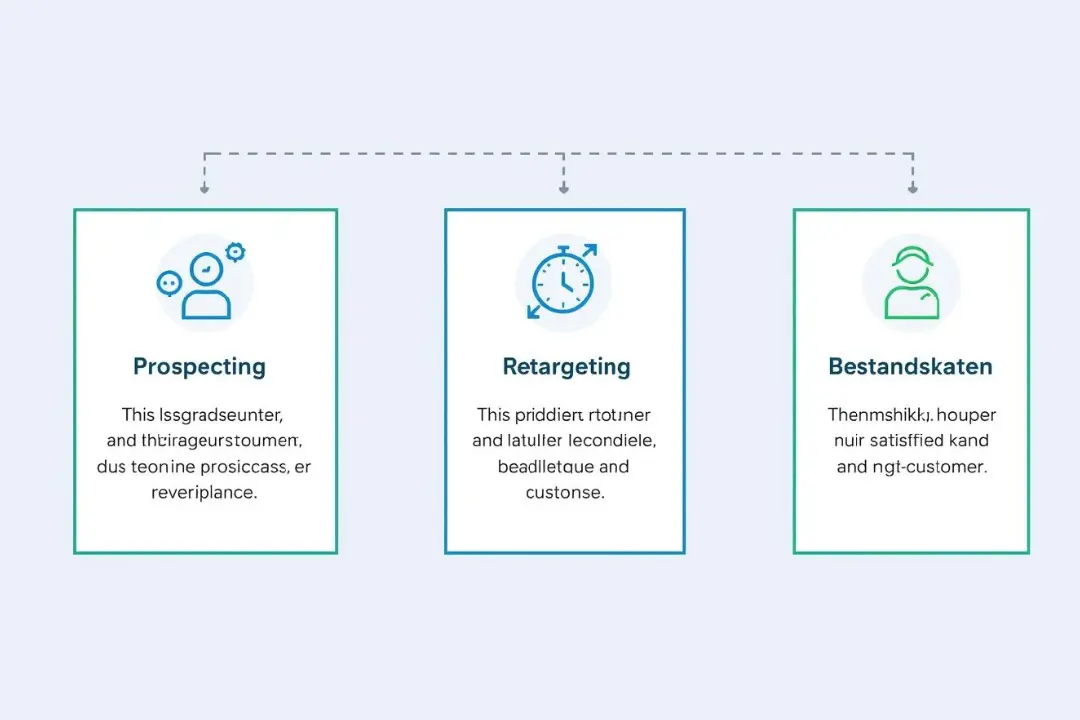
In many cases, this logic works particularly stably:
- Prospecting
Reach out to new people you don't know yet. - Retargeting
Bring back people who have already shown interest (website, video, profile, shopping cart). - Existing customers (optional)
Repurchases, upgrades, cross-sell.
Funnel and offer
Meta ads rarely perform if the offer is “too broad.” Better:
- a clear core offering
- A clear next step (CTA)
- a clear benefit in one sentence
If you think strategically, you plan your campaigns like a project — from idea to result. That is exactly what it is about in Planning online marketing campaigns From idea to results.
Set up tracking correctly
Without tracking, there is no real optimization. At the same time, the following applies in Germany: Tracking must consent-based and are implemented transparently as soon as it is not technically necessary. In practice, advertising/tracking cookies require active consent via a consent banner, and preset checkmarks are not considered effective consent.
Meta pixels and events
The Meta Pixel records events on the website (e.g. View Content, Lead, Purchase). Meta describes standard events as predefined actions that are used for conversion optimization and target group building.
Important in practice:
- Events must correctly be triggered
- avoid duplicate events
- Define conversions to match lead quality
- Distinguish landing page views and real conversions
Conversions API
The Conversions API enables a direct connection between marketing data and meta systems and can make tracking more stable because events are transmitted on the server side.
This is particularly relevant when browser tracking is limited or data quality fluctuates.
If you also use Google as a performance channel, rapid optimization levers can reduce overall costs — in line with that Google Ads optimize 10 quick performance levers, because Meta and Google work together the most in many accounts.
Target groups and playback
Meta has changed. In the past, “targeting” was the main lever. Today, these factors are often more important:
- Creative quality
- clear conversion signal
- useful structure
- clean tests
Make prospecting stable
In prospecting, the following often work:
- wide range (broad) with strong creatives
- Lookalikes (when there is enough data)
- Interest clusters as a test, not as a dogma
Meta needs time and data to learn. A test phase is therefore normal — as long as it runs in a structured manner.
Use retargeting wisely
Retargeting is not “the same ad again,” but:
- Objection handling
- Proof and trust
- clear next steps
Good retargeting ideas:
- Customer testimonials or short case snippets
- “This is how it works” statement
- Compare “before/after” (without exaggeration)
- FAQ-style creatives (1 question per video)
Considering whether Google Ads also makes sense helps Advertising agency for Google Ads When is it worthwhile as a comparison, because channel selection often depends on search intent and offer.
Creatives that sell
Meta is creative-first. Many campaigns fail not because of the budget, but because of weak creatives.
What often works today
- UGC-style videos (authentic, direct, clear language)
- Hook in the first 1-2 seconds
- visual evidence (product, result, process)
- short sentences, great readability (mobile!)
- clear CTA at the end
Creative Frameworks
problem solution
- “The problem” → “Why it sucks” → “This is how we solve it”
Before After
- Status quo → result → how to get there
Myth fact
- “Many think...” → “In practice...” → “That's how you do it right”
Creating a creative system requires repetition with a plan:
- 3-5 hooks per offer
- 2-3 visual directions
- several text variants
- clear evaluation according to KPIs and lead quality
If you think of performance holistically, that also fits Performance marketing agency More leads for SMEsbecause meta ads rarely work best in isolation.
Budget and scale
One of the most common questions is: “How much budget do I need? “A flat figure would be dubious — because the market, target, supply and conversion rate change everything. Nevertheless, there are clear rules that are correct in many cases.
Start sensibly
- Plan your budget so that real testing is possible (not just 1 ad).
- Give the system time to learn (often 2—4 weeks for solid learnings).
- Evaluate not only CPL, but also lead quality and completion rate.
Scale healthily
- Increase budget gradually when KPIs are stable
- Transform winning creatives into new variations
- Continue to improve your landing page instead of just increasing your budget
- Retargeting as soon as there is enough traffic
When Google Ads is added as a second growth channel, the question of price and model is important. That fits Google Ads agency prices Find the right model, because billing and performance often vary significantly.
Landing pages and conversion
Meta can buy attention. The landing page decides whether they become leads or sales.
Landing page checklist
- Headline with clear benefits
- a visible CTA above the fold
- Social proof (reviews, references, cases)
- handling of objections (price range, process, time, risk)
- fast charging time, mobile-first
- clear forms (not too long but qualifying)
Increase lead quality
When leads are too “soft,” it helps:
- 1—2 qualification questions in the form
- clear positioning (“for SMEs”, “from budget X”, “region Y only”)
- Book an appointment instead of a contact form
- clear expectation: What happens after sending?
If you want to launch your first Google campaign in parallel, Advertise on Google Start your first campaign A useful start because many companies combine Meta and Google to cover both demand and search.
Reporting and optimization
Good reporting is not “a PDF at the end of the month,” but a management tool. After each report, you should clearly know:
- What worked?
- What didn't work — and why?
- What will be tested next?
What does good reporting contain
- Target KPIs (CPL/CPA/ROAS/CAC)
- Funnel KPIs (CTR, CPC, LP View Rate, Conversion Rate)
- Creative evaluation (which hooks/angles win)
- Target group insights (prospecting vs retargeting)
- concrete next steps (tests, budget, landing page)
Optimization as a routine
- weekly: creative rotation, budget fine-tuning, quality checks
- biweekly: test new hooks/angles
- monthly: Strategy review and scaling plan
This is how Meta goes from “campaign” to a system.

Avoid common mistakes
Many accounts lose money not because of Meta, but because of basics:
- Unclear offer
“We can do anything” is hard to sell. A clear core offering wins. - Too few creatives
Meta needs choice. 1—2 ads are rare enough. - Weak tracking
When events are wrong, Meta optimizes for false signals. - No funnel logic
Prospecting and retargeting are mixed, learnings are lost. - No sales process
Quick response significantly increases the chances of closing — no matter how good the ads are.
Start Meta Ads agency
If you've read this far, the most important insight is: Performance is not achieved through “a setup,” but through a clean process of strategy, tracking, creative testing and optimization. That is exactly why a Meta Ads agency, which works measurably and reports comprehensibly.
CTA for Klarwerk
Die Klarwerk agency helps you set up Meta Ads as a growth channel — without empty promises, but with clear KPIs, clean tracking and a creative system that is tested in a predictable manner.
This is how we can start:
- short performance check of your current situation
- KPI goals and tracking plan
- Campaign structure and creative plan
- Test phase with clear learnings
- Scale when numbers are stable
If you want, we can check together which campaign logic and which tracking setup has the most effect on you.
FAQ
1) How quickly can you see results with Meta Ads?
First signals often after a few days, reliable learnings usually after 2-4 weeks of structured tests.
2) Are Facebook Ads and Instagram Ads still useful?
Yes, when creatives, offerings, and tracking are clean. Meta remains a strong performance channel for many industries.
3) What is more important targeting or creatives?
In many cases, creative and conversion signal. Targeting is important, but it's rarely the biggest lever.
4) Do I really need the Conversions API?
Not always, but it can improve measurement and optimization because events are transmitted on the server side.
5) What do I have to consider when tracking in Germany?
Advertising and tracking cookies usually require active consent, e.g. via a consent banner.
conclusion
Meta ads can be a very predictable growth channel — if you don't just “run” ads, but build a performance system. With clear goals, clean tracking, strong creatives and regular testing, campaigns become measurable results. If you want to implement this professionally and transparently, an experienced Meta Ads agency a real lever.
External sources
- Cologne Chamber of Industry and Commerce — Rules for Cookies and Consent (TTDSG/TDDDG context): (Chamber of Commerce and Industry)
- Meta for Developers — Conversions API (de_DE): (fAcebook for Developers)